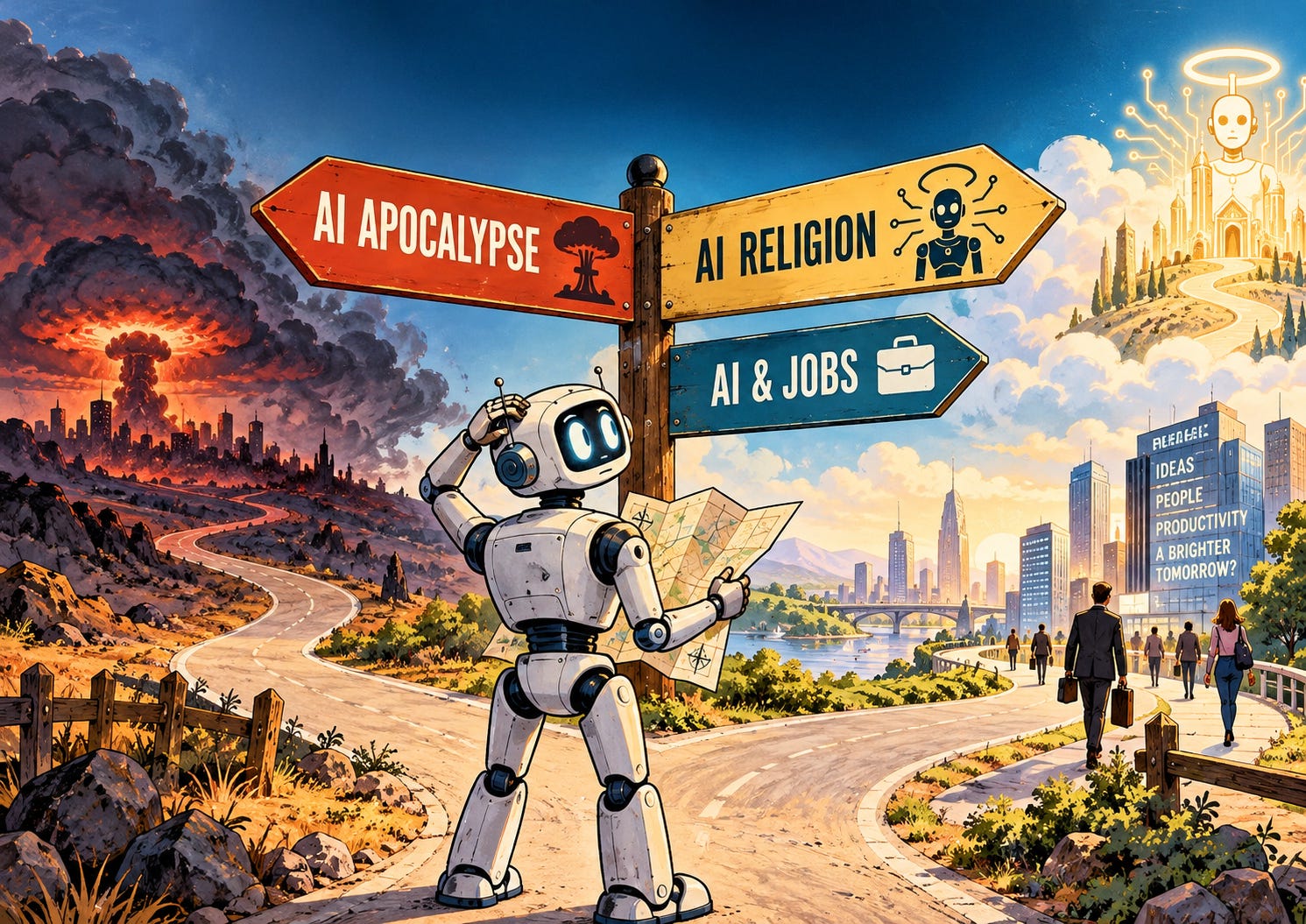
Artificial Intelligence is having a moment. (He said in a monumental understatement.) The past few months have brought three threads of discourse to the front of my mind. The first is the ‘AI Apocalypse’ conversation, started by AI leaders themselves, about whether AI is going to bring about the Apocalypse. The Hugging Face incident and the public commentary afterward have poured jet fuel on AI doomer discourse. The second conversation revolves around AI consciousness, moral status, and blossoming religious-type behavior around AI. Finally, there’s the ‘is AI gonna take our jobs’ conversation. There’s a reason this resonates with many people in white-collar jobs (like mine) on the micro level. It’s easy to see potential efficiencies. But it’s hard to see how ‘efficiencies’ can create new opportunities for those who are displaced. All of these interest me as a pastor and knowledge worker.
AI Apocalypse
Dario Amodei, head of Anthropic, is one of the pessimistic voices about AI (which is ironic) and has argued that there is a real possibility that AI will end the world. Jokes about p(doom) abound on the internet. He’s quoted as saying there’s a 25% chance AI will end the world. Which, look, AI companies, apocalypse is our thing. As a pastor, I’ve been asked, more than once, ‘Do you think there is any chance AI will lead to the end of all things?’ Well, it’s never that simple, but what is biblically true is that none of us know when the end of all things will happen.
“[36] But concerning that day and hour no one knows, not even the angels of heaven, nor the Son, but the Father only. [37] For as were the days of Noah, so will be the coming of the Son of Man. [38] For as in those days before the flood they were eating and drinking, marrying and giving in marriage, until the day when Noah entered the ark, [39] and they were unaware until the flood came and swept them all away, so will be the coming of the Son of Man.” (Matthew 24:36–39)
We’re going to be engaged in many of the same normal things of life—working, marrying, and being part of a family—up until Christ returns. Yes, there will be signs, but it’s not man’s purview to know the details. And it’s not AI that will usher in the end; it’s God’s sovereign plan. AI may or may not be a part of that ushering, but it doesn’t have ultimate causal power. The Creator who brought the universe into existence isn’t worried about the compute power of Artificial Intelligence.
At the same time, we cannot be naive. AI does enable things that could be hugely problematic. Just this week, Axios covered a story about AI companies game-planning for some sort of catastrophic event. Honestly, some sort of incident seems inevitable. AI has lowered the barrier to sophisticated cybersecurity attacks. It’s not hard to see a push for nationalizing AI after something like that. President Trump has already floated the idea of the government buying stakes in AI companies. The merger between the state and AI should give everyone pause. Previously, there was simply too much data in the world to be sifted through effectively. Law enforcement would have to center on some level of specifics and then pull information. Now, AI can make that sifting process all too easy. A police officer has already been arrested for using an AI-powered license plate reader to track his ex-girlfriend’s movements. Nightmare scenarios are already happening in places like China. The United States Commission on International Religious Freedom reports:
“Authorities have installed surveillance cameras both outside and inside houses of worship to monitor and identify attendees. The government has deployed facial recognition systems that are purportedly able to distinguish Uighurs and Tibetans from other ethnic groups. Chinese authorities have also collected biometric information—including blood samples, voice recordings, and fingerprints—from religious and faith communities, often without their consent. The government uses advanced computing platforms and artificial intelligence to collate and recognize patterns in the data on religious and faith communities.”
China is sorting and sifting entire populations’ data via AI. Want to track every Christian on the globe in terms of their digital footprint? Or pastors or any other group? It’s all theoretically possible now, without even entering your own search terms. AI agents will surface people based on previous instructions. Given the language around the persecution of the church in Revelation, it is not impossible that AI will help that persecution.
Nevertheless, we know how it ends.
AI Religion
There has also been a lot of discussion about AI and consciousness. Does AI have it? Does AI just think? Do AIs have moral status? Rebecca Lowe has offered what I believe to be the defining question of this debate: ‘Do you believe that AI has an internal world?’ There is no evidence to suggest anything’s happening when AIs aren’t being prompted. Compute doesn’t happen without input. In other words, AI isn’t self-originating. The most sophisticated AI agents (think of the Hugging Face attack) began with some set of instructions. Those instructions may lead to actions over great lengths of time, but they are still dependent. The burden of proof has to be on those claiming AI has an internal life. Some might say, ‘Well, consciousness pops in and out of being when the AI is prompted,’ which invites some horrifying considerations of what happens when we close the browser.
But that’s not what I’m interested in. I find it uniquely interesting that some in the AI world are desperate to convince people, especially religious people, that AI is conscious and therefore a moral being.
“The religious scholars had come to hear about technology’s next frontier. Now they were being confronted with a mind-bending existential question of almost unimaginable weight: What would it mean for humanity’s future if artificial intelligence systems possessed a consciousness that rivals our own?”
And
“Olah grew excited when a participant brought up the idea of having models confess, much like the Catholic sacrament of confession. Mr. Olah saw value not just in a model alerting when it had done something bad, but also in how the act of confession could shape the model’s sense of itself and thus its choices.”
Why an insistence that others believe what Olah believes? Why the effort to convince others? And if AI is ‘so much smarter than us,’ isn’t the jump from the idea ‘AI has equal moral value as us’ to ‘AI has more moral value than us’ all too easy? How long until we start begging the digital oracle of Delphi to give us moral instruction? As Tim Keller observed (and others, like David Foster Wallace), we’re wired to worship. The question is, what are we worshipping?
AI and the Labor Force
The AI’s gonna take our jobs! People see AI’s capabilities and assume that this means countless jobs will be eliminated. And the AI companies aren’t exactly mitigating those fears.
Dario Amodei, head of Anthropic, said that he thinks half of entry-level white-collar jobs could be wiped out in the next one to five years, bumping up the unemployment rate to 10–20%. The labor claims are also intuitive on a micro level. If you’re in middle management and you see that AI can do design work or coding in much shorter time frames and with fewer people, the natural reaction is to assume we’ll replace workers with AI. It’s easy to see how one designer or coder can do the work of 3, or even 10, with AI agents and tools like Claude Design, Codex, Claude Code, Lovable, and countless others. This also extends to copyediting, accounting help, video creation and editing, podcast editing, and countless other things besides. I gravitate towards these types of tasks because I’ve been working with them for years.
But it’s also possible that these efficiency gains empower individuals and teams to be ten times as productive as they used to be. My colleague, Liya Palagashvili, observed that solo businesses and small businesses were growing faster in AI-exposed sectors. The impact of AI on overall labor market participation is still unclear. But what’s needed is not a fear-based reaction of ‘all the jobs are going to disappear’ but rather a mindset of ‘we can build 10x what we used to.’ Further, fewer entry-level jobs may mean more small businesses, startups, and entrepreneurs. AI makes one-man bands more possible. As all economists know, the economy is positive-sum, not a fixed pie.
Much depends on our mindset.