


On Starting Chess at 40
On August 17, 2023, I began my complicated participation in the game of chess. I was 40 at the time and, like every great world champion, figured 40 was the optimal age to start the most complicated board game in human history. Really, it was rooted in a simple desire: to beat my dad. He smashed me in chess growing up, never went easy, and cackled when he trapped me in some nonsense. I never got past learning the moves.
Despite those drubbings, I still wanted to learn. In 2006 I even bought Chess for Dummies (published in 2003, when Kramnik was still the fresh-faced up-and-comer). Looking back, it’s hilarious. Sport or game, whatever you call it, it’s slightly less active than golf.
Benefits of Chess
Starting chess at 40 means losing a lot, often to children under 10. Yet I kept returning. The first thing I noticed was the focus it demands. While playing, my mind is fully occupied. The only other experience like it is combat sports. I’ve trained in Brazilian jiu-jitsu, boxing, wrestling, and MMA for more than 25 years, and the joy is the same: total immersion. There are no bills, no work stress, no distractions greater than someone trying to choke you. Chess comes closest to that flow-state and without the bruises.
Second, there’s evidence chess supports cognition. Learning new skills as we age helps fight mental decline, and studies suggest correlations between chess and reduced dementia risk.
Third, chess connects you to a tradition 1,500 years old. Kings, sheiks, gentlemen, and now online gamers have all played. It even gives you the chance to be a little snobbish about your hobby.
Most of all, chess teaches humility. You cannot get better without losing constantly. I’ve lost 1,600 games online and dozens in person, including to kids as young as seven. Even my 10-year-old daughter has a win against me (there were extenuating circumstances!). Combat sports taught me the same: everyone loses, and even champions eventually decline. The question is whether you treat losses as excuses or as opportunities to learn.
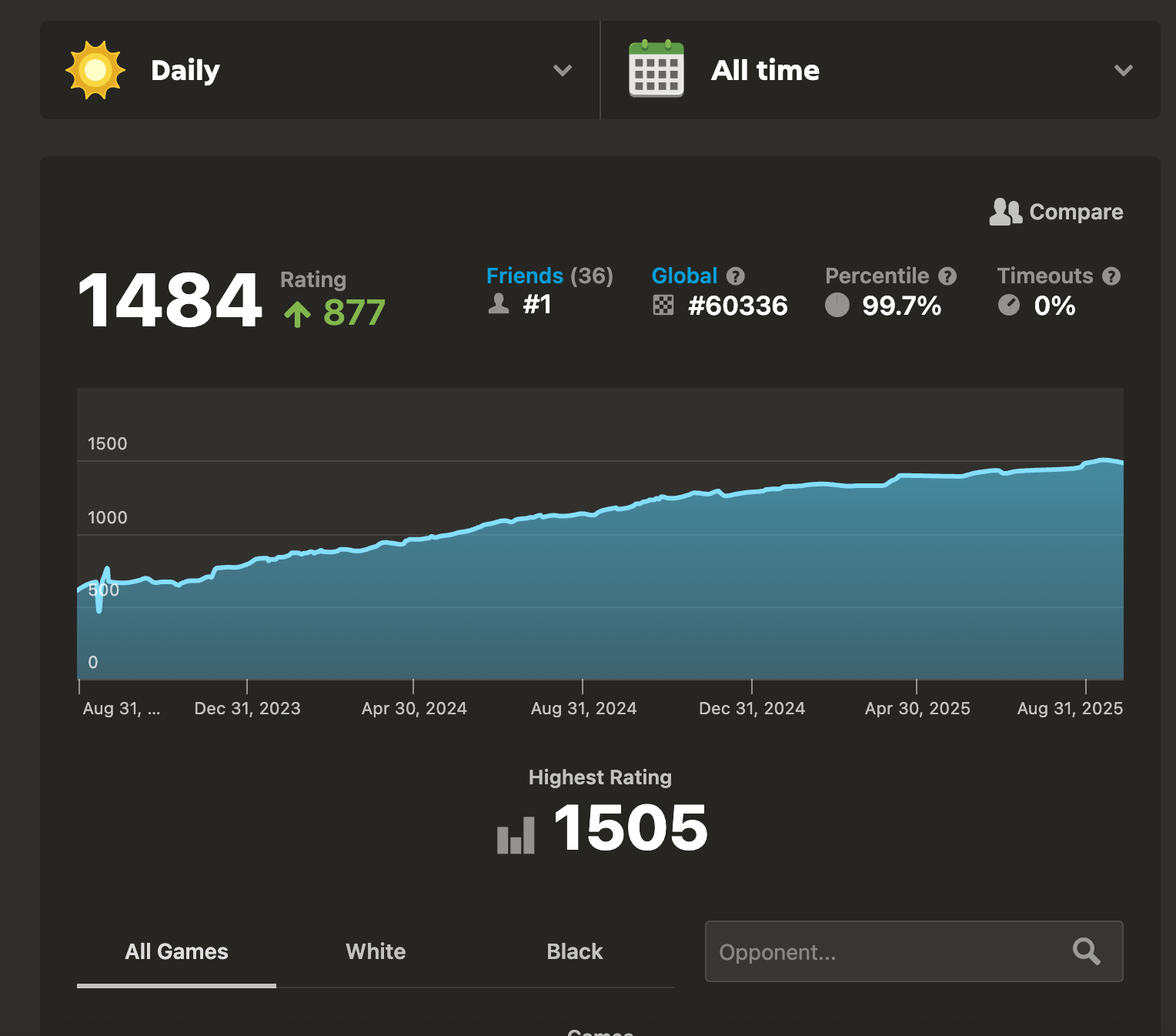
Finally, chess rewards work. For just over two years, I’ve spent 15 to 30 minutes a day, three to five times a week, practicing. I’m now in the top 99% of Daily time-control players on chess.com. Dedicated practice pays off. The deeper lesson? Young people overestimate what they can do in a year and underestimate what they can do in 30. Chess points to that reality.
Pastoral Warnings
David Shenk, in his book The Immortal Game, describes a scene that serves as a warning.
“Large rocks, severed heads, and flaming pots of oil rained down on Baghdad … Outside the circular city’s main wall … soldiers pressed forward … Amid sinking boats and burning rafts …
Within the round city’s imperial inner sanctum … Muhammad al-Amin … was playing chess against his favorite eunuch Kauthar. …
A trusted messenger burst into the royal apartment with urgently bad news. …
‘O Commander of the faithful,’ implored the messenger … ‘This is not the time to play. Pray arise and attend to matters of more serious moment.’
It was no use. The caliph was absorbed in the board. …
‘Patience my friend,’ the caliph calmly replied … ‘I see that in a few moves I shall give Kauthar checkmate.’
As Shenk describes, al-Amin kept playing even while the palace crumbled around him. When defeat was certain, he tried to flee the palace by boat on the Tigris River. His escape effort fails and he’s captured and quickly beheaded. Shenk lingers on the irony: the caliph who had been too absorbed in the careful strategy of chess had failed to apply any strategy to his real war and it cost him his throne and life.
While I am no king or commander, I’ve lost hours to pointless and undisciplined chess playing. Ironically, in the simplest sense, chess is a video game now. Despite all its intellectual trappings and sense of high-mindedness, it is a game on a screen that can sap you of all your time. Like so many things that pull on us, chess can numb the heart to the things of God and serve as an idol that leads us to spend one of our most precious resources, time, on a game. Be careful and prudent. Steward the time and the mind that you have well.
Conclusion
Chess has been helpful in giving me focus, fun distraction, and some level of mental discipline. Yet, it’s also tipped into sinful time wasting. Ephesians 5:15–17 remains a good reminder of how we ultimately ought to use our time, for the glory of God.
[15] Look carefully then how you walk, not as unwise but as wise, [16] making the best use of the time, because the days are evil. [17] Therefore do not be foolish, but understand what the will of the Lord is. (ESV)
There are some who can take that verse as license to overwork or sacrifice everything for ministry, but that’s not the heart of that section of text, it’s a call to invest in things that last, relationship with God, church, and family. Chess can be part of that well ordered life, but only when it’s in balance.
But more importantly, I beat my Dad.
Well done, Ben!